CyberAxe (Augmented Axe Throwing)
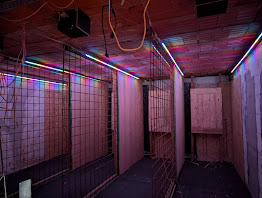
CyberAxe is an augmented axe-throwing installation plunging players into a technological war against an out-of-control governance AI. Designed and produced by Crafteke to accommodate 16 simultaneous players across 4 lanes, the system combines immersive storytelling, custom detection technology, mobile control, and photobooth integration.

Universe & Spiritual Successor to Dystopia
- Link to Dystopia Escape Room: CyberAxe serves as a direct sequel to the cyberpunk escape room Dystopia, where players acted as hackers infiltrating a government research lab to steal the positronic cube housing the governance AI.
- Concept & Story: As a direct consequence of this release, the AI took full control of global infrastructure. Backed into a corner, humanity turns to the only analog weapon still effective against waves of robots: the axe.
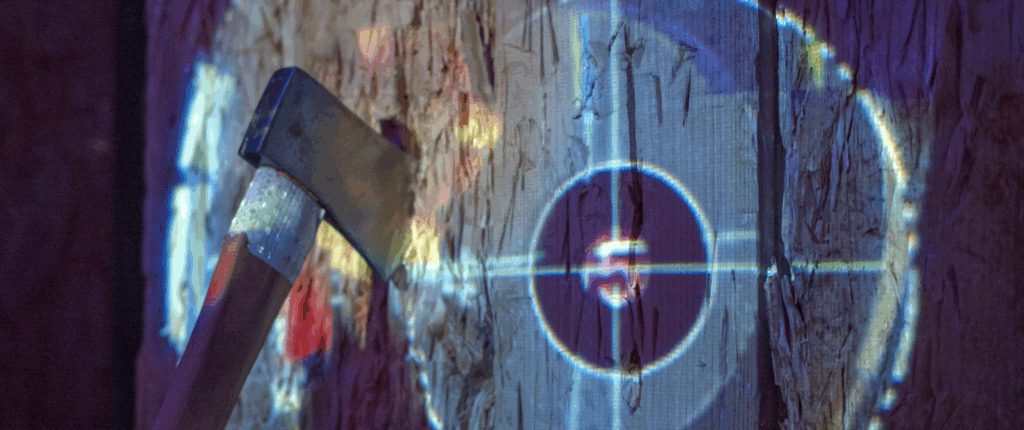
- Narrative Game Design: Translating the story into evolving game modes where each successful throw destroys cybernetic units projected on screen.
Engineering & Impact Detection
1. Impact Detection & Custom Technology
Challenge: Process physical impacts with imperceptible latency while eliminating false positives caused by vibrations from adjacent targets.
Solution: Deployment of a custom-developed proprietary detection solution. Independent electronic modules per lane communicate directly via OSC/UDP with the game engine. Custom calibration software adjusts sensitivity based on wood plank wear, achieving a 99% success rate (the remaining 1% consisting of edge cases that would already be debatable in a traditional throwing game, such as grazing hits or weak throws).

2. Multi-Lane Architecture (1 PC / 2 Projectors)
Challenge: Centralize computation for 4 independent lanes (16 simultaneous players) on a single workstation to simplify on-site maintenance.
Solution: Optimization of the rendering engine redistributing the video feed across two projectors. Parallel management of all 4 sensor streams and synchronization of DMX/Art-Net show control to trigger lighting effects on targets whenever a robot is destroyed.
Design, Operational Tools & Features
- Mobile Game Master Interface: Development of a dedicated web interface accessible via smartphone, allowing operators to manage user groups, launch game modes, and perform remote sensor calibration.
- Photobooth Station & Dynamic Avatars: Integration of an interactive photobooth where players take photos before playing. Their faces are dynamically integrated into the game on targets and enemies, unlocking custom gameplay modes built around this mechanic.
- UI Prototyping (Unity): Ergonomic modeling and testing of the player interface in Unity (C#) before porting to Godot Engine.
- Art Direction & Sound Design: Development of the cyberpunk visual identity and complete sound design (impact sound effects, interface audio feedback, and industrial music tracks).
- Hardware Enclosures (Fusion 360): 3D modeling and printing of shock-resistant integration enclosures to protect detection electronics in situ.
Technical Summary
- System accuracy: 99% valid detection rate across thousands of recorded throws.
- Responsiveness: Visual and audio feedback delivered under 50 ms after impact.
- Operational workflow: Full remote management via smartphone for the Game Master (controlling groups, lanes, and calibrations).
- Throughput capacity: Smooth rendering across 4 parallel lanes supporting up to 16 simultaneous players.
One Build, Every Hat
The stand, electronics, and software were built from A to Z by the same small team: a single day on site could go from soldering iron and code at the workshop, to structural work on site, to installation and sensor calibration under real conditions.